See also: Front-Page News in Ashtown Valley · PCBs Arrive! · Tomato site
I decided to keep the web stack strictly Vanilla: static HTML, CSS, JavaScript, and raw Three.js (0.169.0 via import map) without React or a bundler. This avoids framework bloat and keeps the footprint light. I used OrbitControls and demand-render (only drawing when dirty or on screen) with a pixel ratio capped at 1.5. However, rendering a complex KiCad PCB in a browser is inherently heavy, so I needed a major optimization pass.
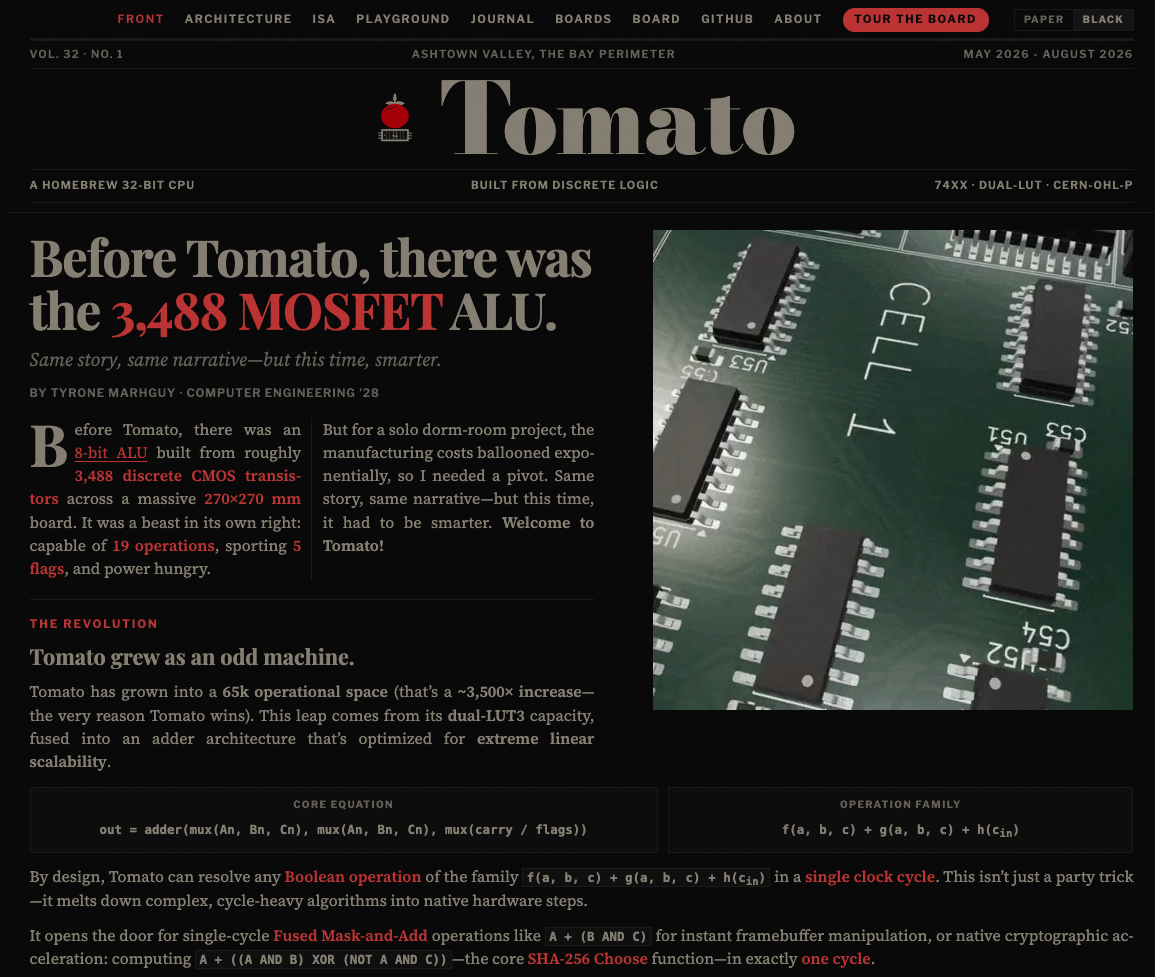
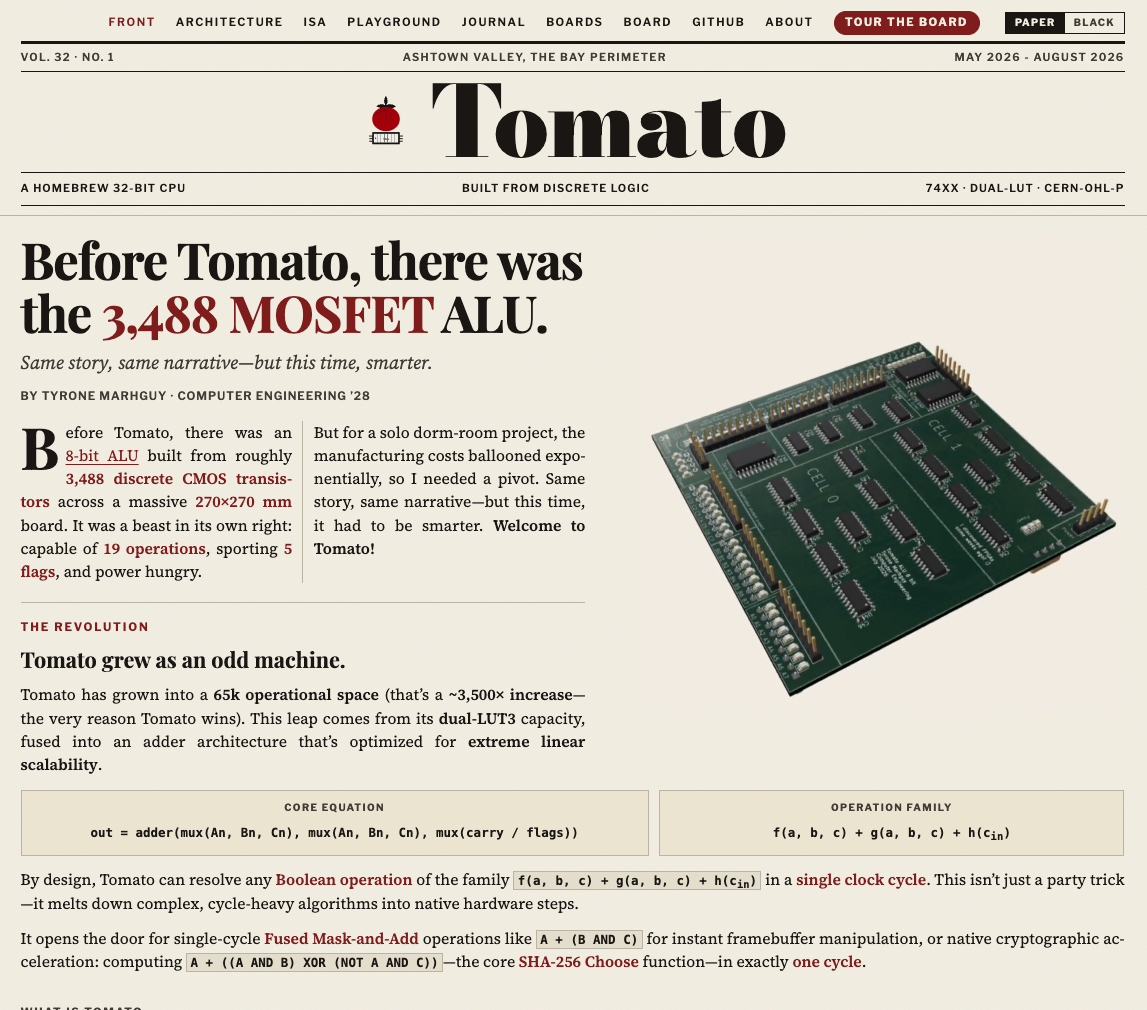
Tomato black theme, white theme.
Before & After Metrics
| Before (raw KiCad in the tab) | After (what ships) | |
|---|---|---|
| GLB | ~31.0 MB | 1.26 MB (Draco) |
| Draw | ~41k meshes (pad/trace) | 9 meshes / 13 primitives |
| Copper | Palette welded it under mask | Separate copper/mask/silk/FR4/pad |
| Merge | Ran on every mesh on main thread | Still in pcb-look.js; skips if < 32 meshes |
The GLB Export Pivot
Originally, the 3D model of the ALU was a monolithic ~31MB .glb file straight out of KiCad 10.0.4, carrying roughly 41k pad/trace meshes. To shrink this, I pushed it through glTF-Transform v4.4.2.
The shipped file (web/assets/pcb/alu.glb) is now 1.26 MB on disk, consisting of exactly 9 meshes, 13 primitives, 13 materials, and 9 nodes. The only extension used is KHR_draco_mesh_compression.
Crucially, KiCad's "Texture Atlas / Palette" option was turned off. This is true and load-bearing. If we ran a palette() then join(), it welded the copper under an opaque mask—traces stayed in the buffer and didn't show. The pipeline that actually ran in optimize-pcb.mjs does not palette() or simplify(). Instead, it was:
dedup → join(keepMeshes) → flatten → join → weld → prune → sparse → draco.
This keeps the layers separate (*_copper, *_pad, *_silkscreen, *_soldermask, *_PCB, plus a few footprint meshes like SOIC-16, LED 0805, C 0603, R-array SIP9). Keeping these distinct allows our pcb-look.js script to dynamically apply shiny clearcoat to the mask and high metalness to the pads.
The ~3.5-Second Main Thread Freeze
Before this optimization, the ~31MB model had thousands of un-instanced meshes, which choked Three.js draw calls. To compensate, we were running a custom mergeByMaterial script on the client side that iterated through every mesh and merged their geometries before rendering.
Running this on the browser caused a massive main-thread freeze. A checked-in Lighthouse run (13.4.0, Chrome extensions on) recorded a Total Blocking Time (TBT) of 3,130 ms, a Max Potential FID of 3,530 ms, and an overall Performance score of 43 (though Accessibility and SEO both hit 100, and Best Practices 96).
Because the new export is already joined by material in glTF-Transform, the client-side merge now skips entirely since the mesh count is under 32. We didn't actually rip out mergeByMaterial / bakeGeo / mergeGeometries—they still live in pcb-look.js—but both viewer.js and bench.js just call a single load path, and the merge bails out early. Draco still decodes and materials still get dressed, so it isn't a zero-overhead load, but the ~3.5s freeze is completely gone.
Lighting & Material Contrast
For the materials:
- Dropped ambient
hemiIntensityto0.6to introduce deep, realistic shadows. - Set the soldermask clearcoat to
1and opacity to0.86, with a deep green color (#1a9a48). - Copper is
#c4a020and FR4 is#0c3320, allowing the bright, metallic copper traces underneath to physically shine through the deep green gloss.
Media & Assets
- Front Page Hero: Replaced with
assets/pcb/hero.gif(clicks through toviewer.html). The source washero.mp4(23.2 MB, 1080x1080, 30 fps, 17.90s, H.264). The GIF on disk is 16.6 MB, 480x480, 10 fps with a full 256-color palette (a 720@15 palette pass was 51 MB, hence why the 480/10 version exists). - Then/Now Plate: The lot 07 plate is
pcb-arrive.webp(1120x1120, 280 KB), shot by hand. - KiCad Orbit Spin: The old
immersion_white.gifwas 9.6 MB, 480², 223 frames. Front no longer uses that spin as the lead. The README was left as KiCad spin + physical photo side by side. - Viewer Details: The 3D viewer now features a story rail (closed Catmull-Rom), a mask peel effect, and captions. Any drag or scroll aborts the tour to hand you a 1:1 orbit. No extra camera library needed. (We tried a film-style pass with letterbox and fog, but removed it).