See also: Writing — open source · Projects — open source · First contributions
Open-source contributions are getting exactly as fun as I'd hoped. It once felt like a hard barrier to enter, but now feels quite natural — and necessary — as writing my own code. In an exciting turn of events, I've gotten merged contributions in LibreLane, Verilator, OpenFPGA, and now OpenROAD.
I started small, focusing on documentation just to understand the mechanics of open-source contribution — how a repository actually receives, reviews, and integrates changes before you start touching the core logic. But the underlying motivation has always been the same: the thought that someone out there will be using these tools to design a chip, run simulation and verification, or map out an architecture, and because of my code contribution, their workflow simply won't break. They won't have to stress over deprecated synthesis flags or pipeline failures; their flow will just happen.
Recent merges & contributions
| Project | Contribution focus | Pull request |
|---|---|---|
| OpenROAD | Production LEF files with trailing whitespace now load | #11107 |
| LibreLane | Yosys ≥ 0.68 abc -fast gating — 3.0.8 | #1015 |
| LibreLane | Pre- and post-synth check errors both count — 3.0.10 | #1016 |
| Verilator | Linux peak memory reporting | #8070 |
| OpenFPGA | Contribution guide & interconnect documentation | #2682, #2683 |
Today, OpenROAD. Production tech files had a stray space after the semicolon in MINWIDTH WRONGDIRECTION, and they wouldn't load. PR #11107 fixes that so they do.
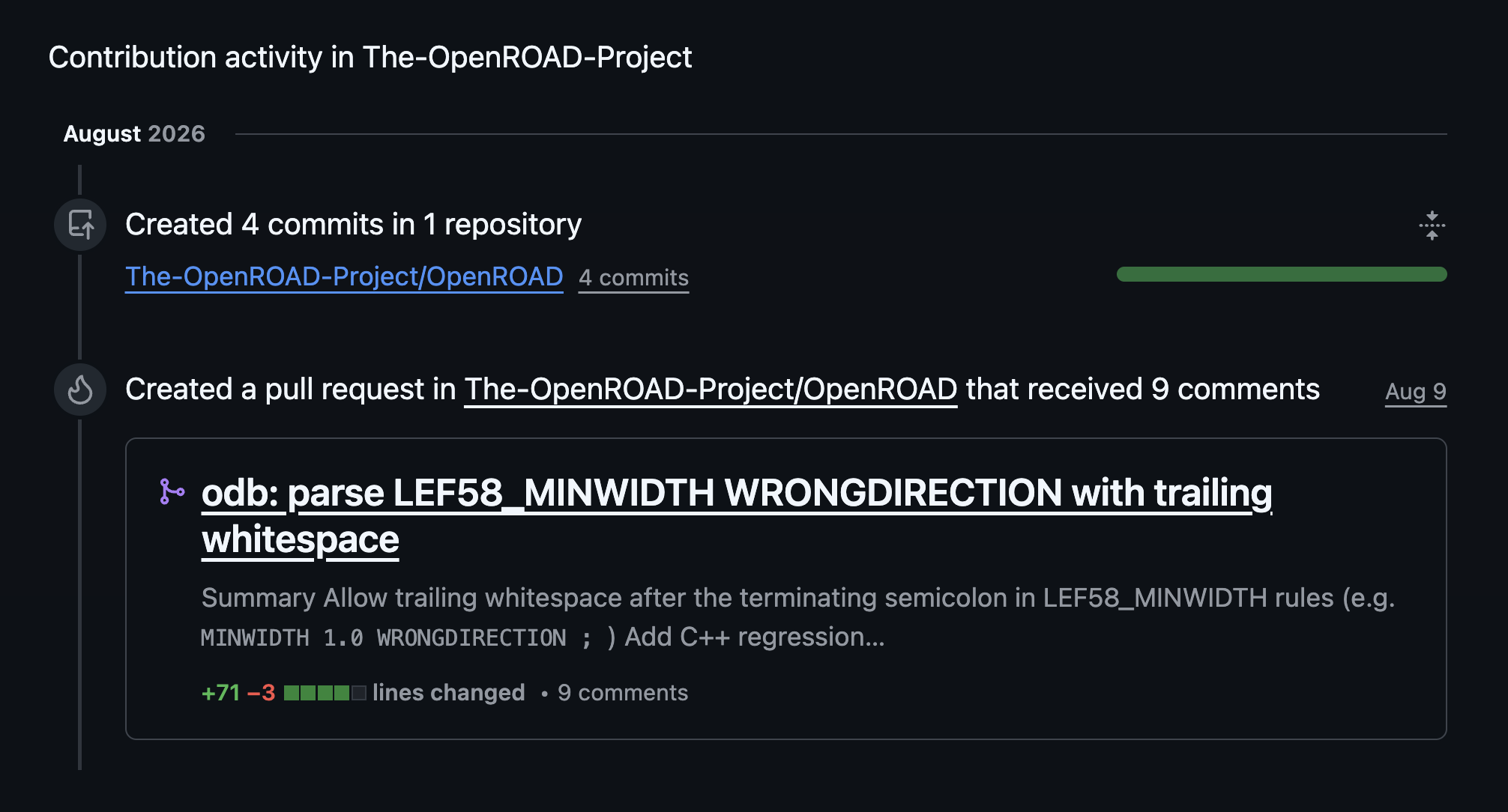
OpenROAD — four commits and #11107.
That LibreLane row closed the loop. PR #1015 is the only change in LibreLane 3.0.8.
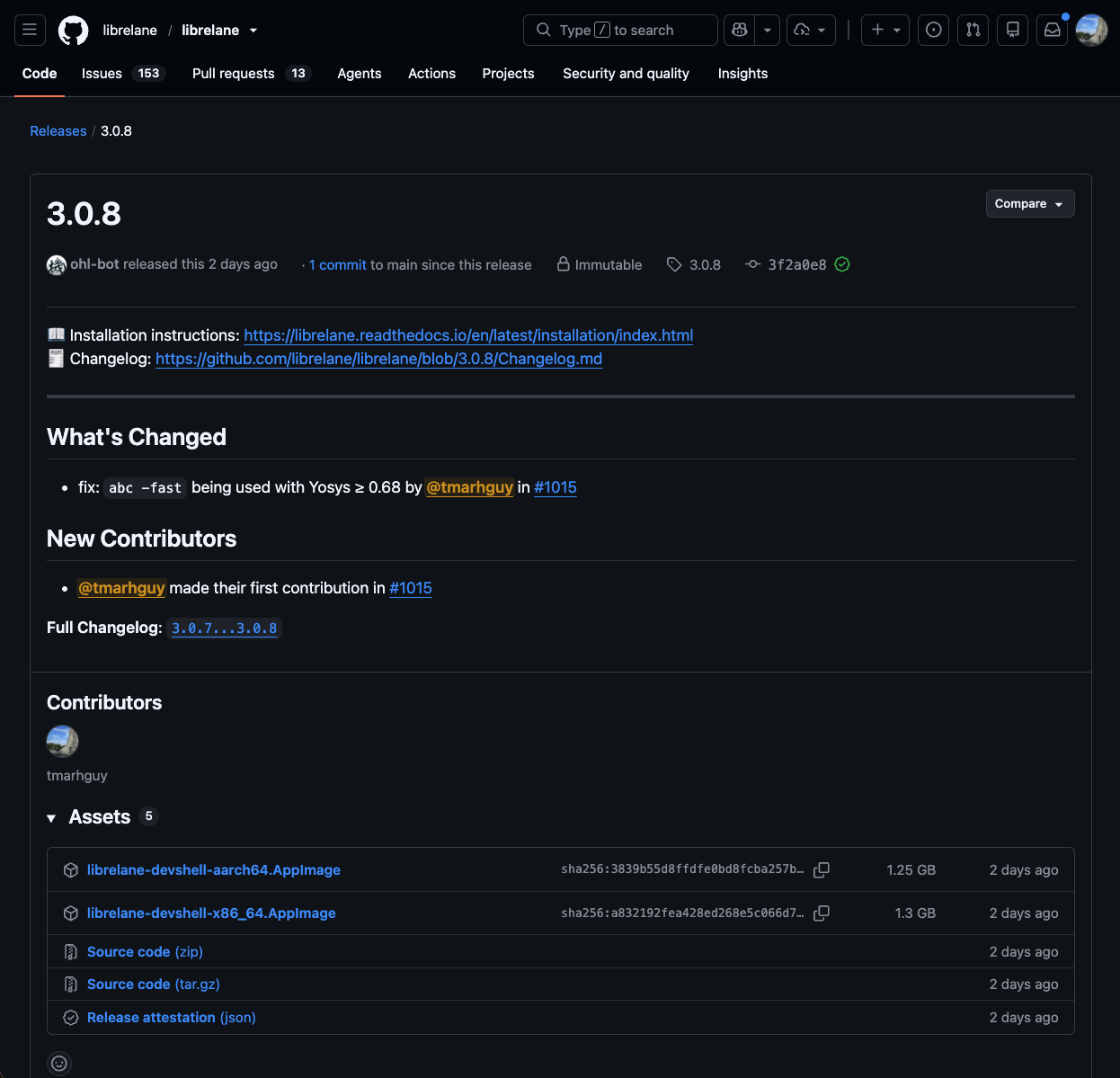
LibreLane 3.0.8 — #1015 is the change that shipped.
And today, PR #1016. Yosys was only counting pre-synthesis check errors, so the metric didn't match chk.rpt — the report people actually open. It now sums both reports. That landed in LibreLane 3.0.10.
I get to sit here at Penn, building my own low-level architecture projects, learning exciting new things, and finding better ways to contribute back to the community. There's a profound satisfaction in knowing that while I'm routing my own boards and working on my own designs, I've had a hand in making someone else's beautiful engineering narrative a reality.